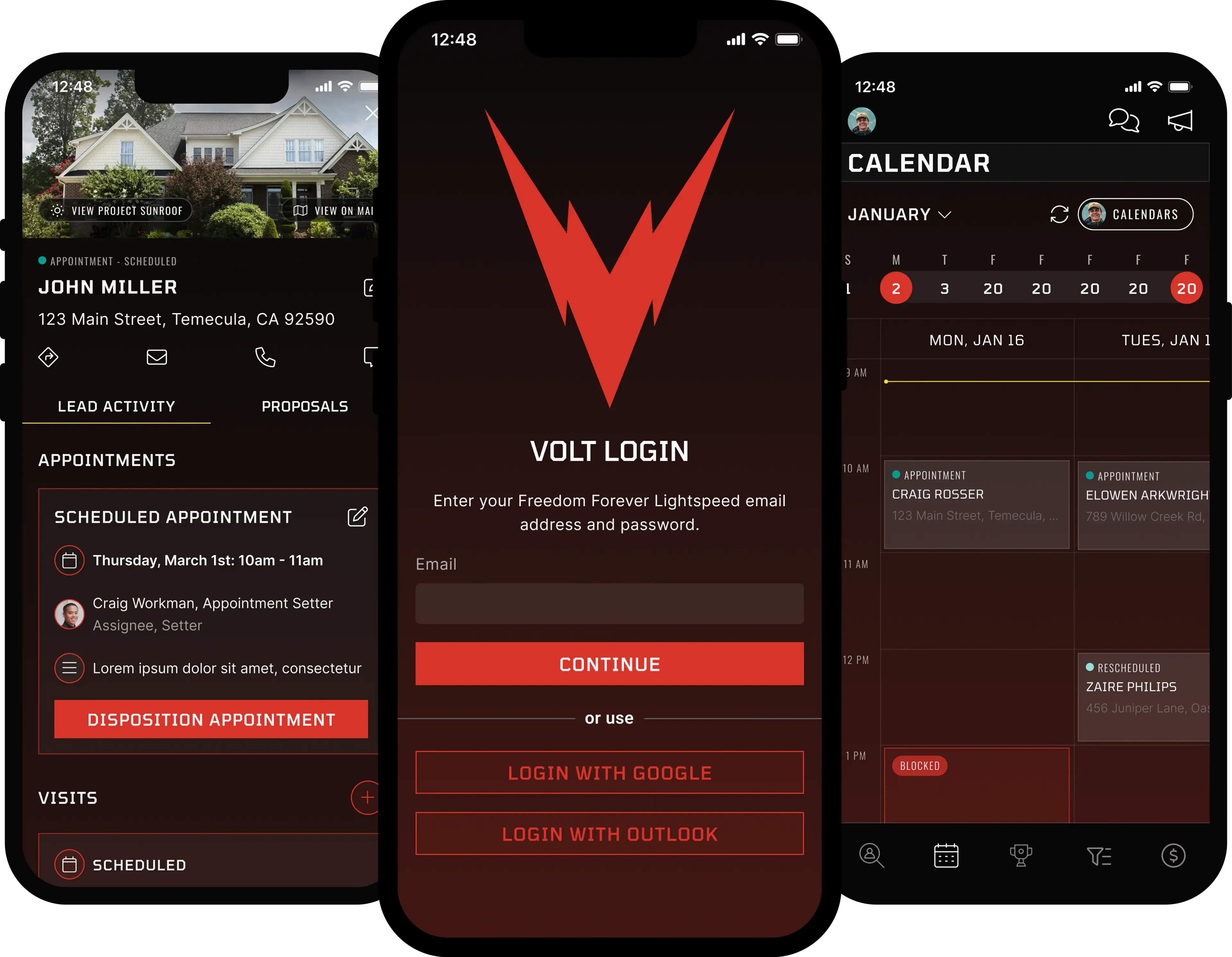
A mobile app rebrand, a design system, and what happens when a designer gets into the code 🤗
I led design and user research for Volt, Freedom Forever's proprietary mobile sales app—from MVP through two full redesigns, and countless enhancements and feature releases. Recently I crossed into front-end AI engineering and built a design system in code, shipped the full redesign, and developed AI-powered tooling the team used to ship faster and implement design consistently.
My case studies here are all related to Volt 2.0. The Volt 2.0 iteration wasn't just about the new look and design system—it was about new AI workflows that empowered me to elevate the UX and UI of the shipped product, work faster and communicate better with PMs and developers, and dive into the data directly to correct misalignment between a gamification feature and actual user behavior.
My role: Lead designer and front-end design engineer
Scope: Design system, component library, Figma-to-code theming architecture, AI-assisted coding, AI design agent and skill creation
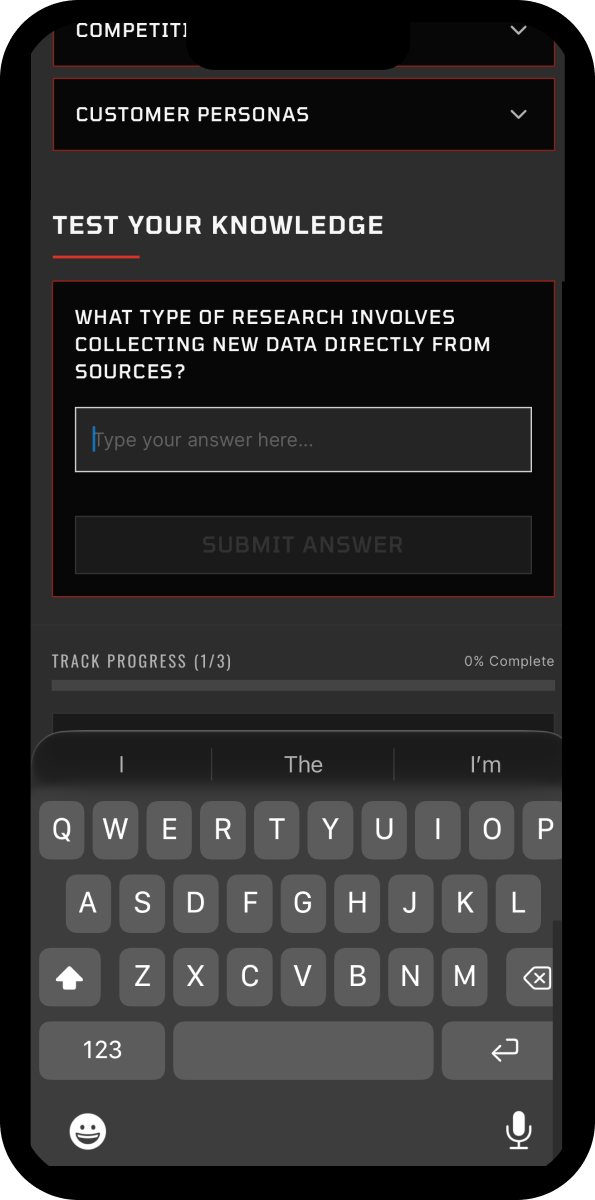
Rapid research and prototyping for an in-house LMS
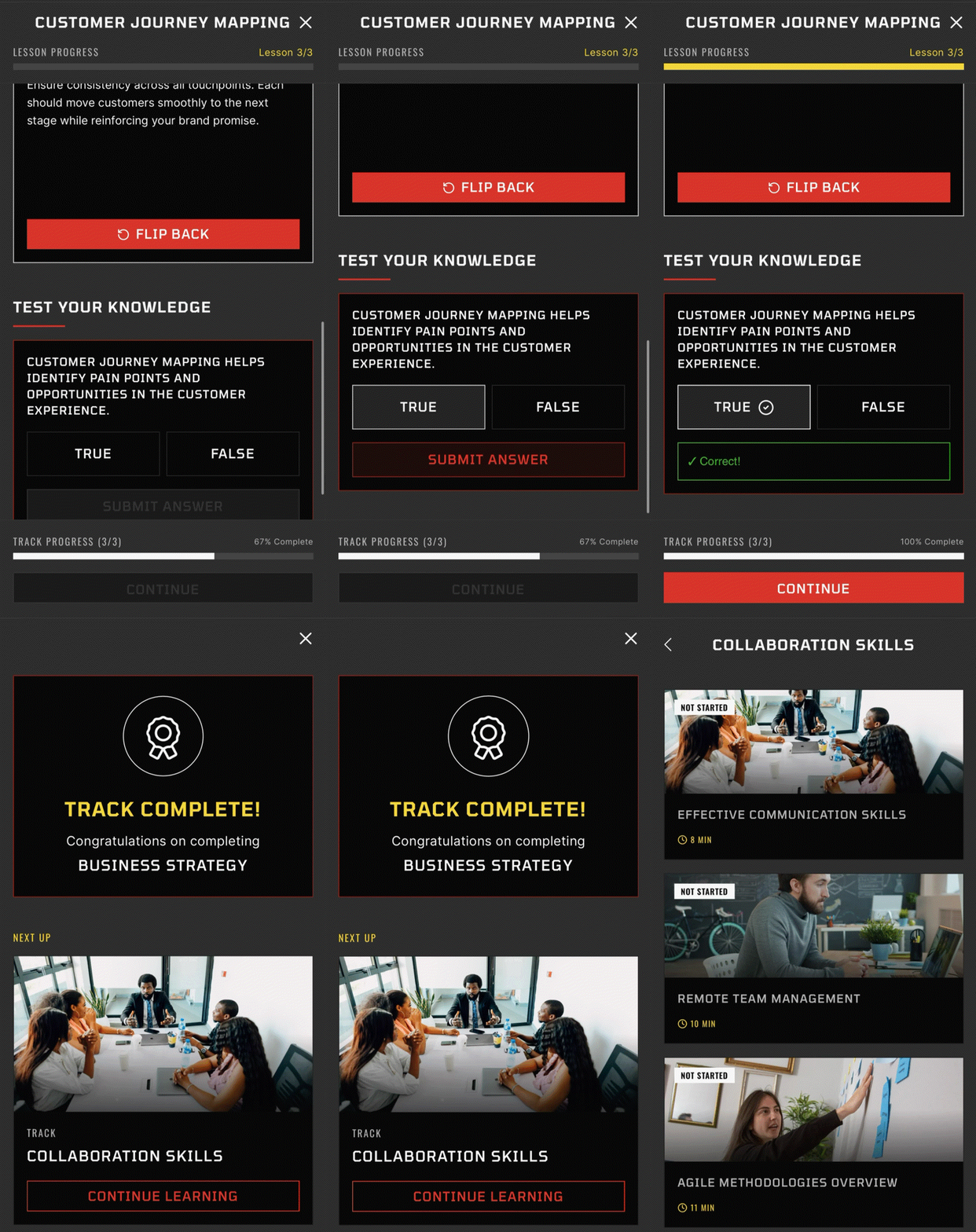
Solar University is an in-house Learning Management System (LMS) kicked off by our PM and senior developer while I was still heads-down finishing the Volt 2.0 redesign. Building an in-house LMS would have been time prohibitive just a handful of months prior, but with AI we could do it ourselves in a fraction of the time. This also meant the PM and developer could utilize AI to handle the early design scaffolding. In order to get my design direction in without stalling the rebrand, I conducted a compressed design process: a full UX audit with AI-assisted note-taking, an AI-research and brainstorm session that both validated my instincts and surfaced new ideas, and an interactive prototype delivered in under a day.
My role: Lead designer
Scope: UX audit, online learning research, rapid prototyping, AI-assisted design


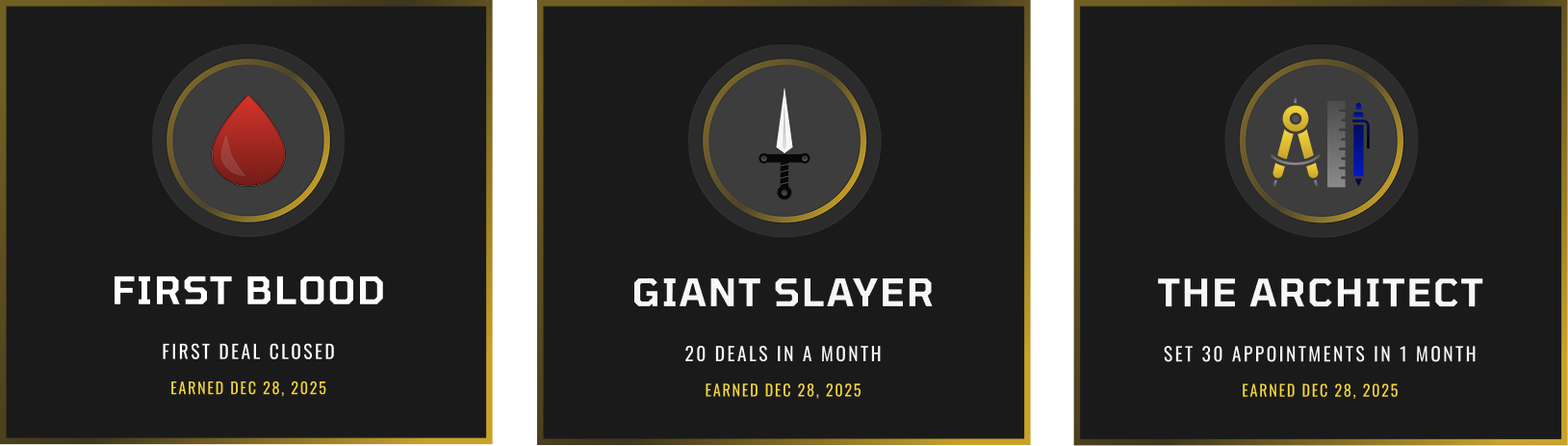
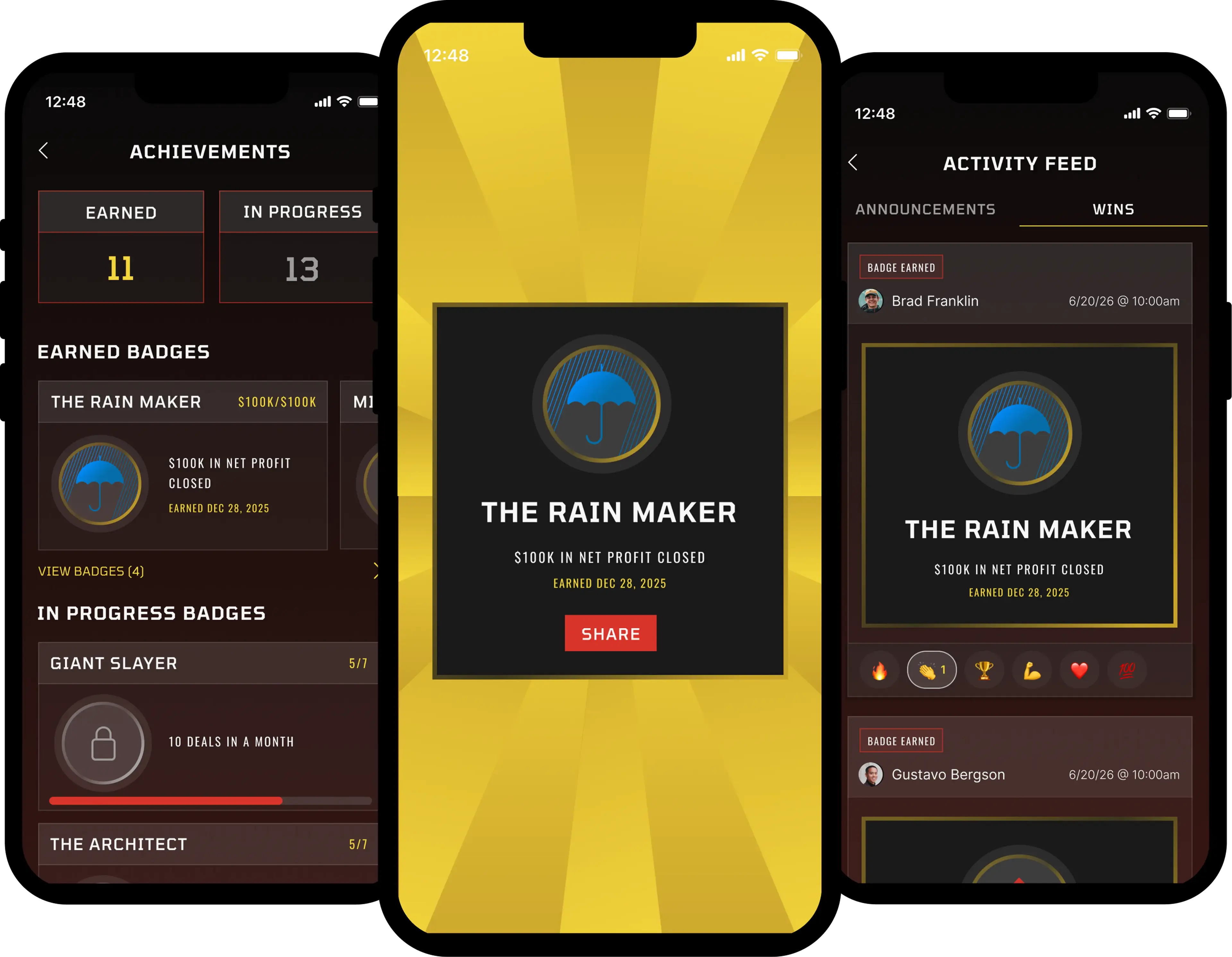
A badge achievements system grounded in the data and how motivation actually works
Gamification in Volt was a longtime goal based on a fundamental understanding of our users and how sales reps are wired and motivated. I was asked to design motivation and incentive features for Volt at numerous points over the years, but beyond the general leaderboard and competitions, gamification features were sidelined for core project management and communication tools.
Finally, a badge achievements system—integrated with native notifications, an admin tool for managing badge content, and a social wins feed—was just days from shipping when Freedom Forever filed for bankruptcy. This case study is about what led up to this near launch: how I used data and research to correct unrealistic badge thresholds and proved my new Volt 2.0 design system and AI-powered workflow could lead to a faster, more direct path from design intent to shipped code.
My role: Lead designer and front-end design engineer
Scope: Feature design, data analysis, gamification system, AI assisted coding